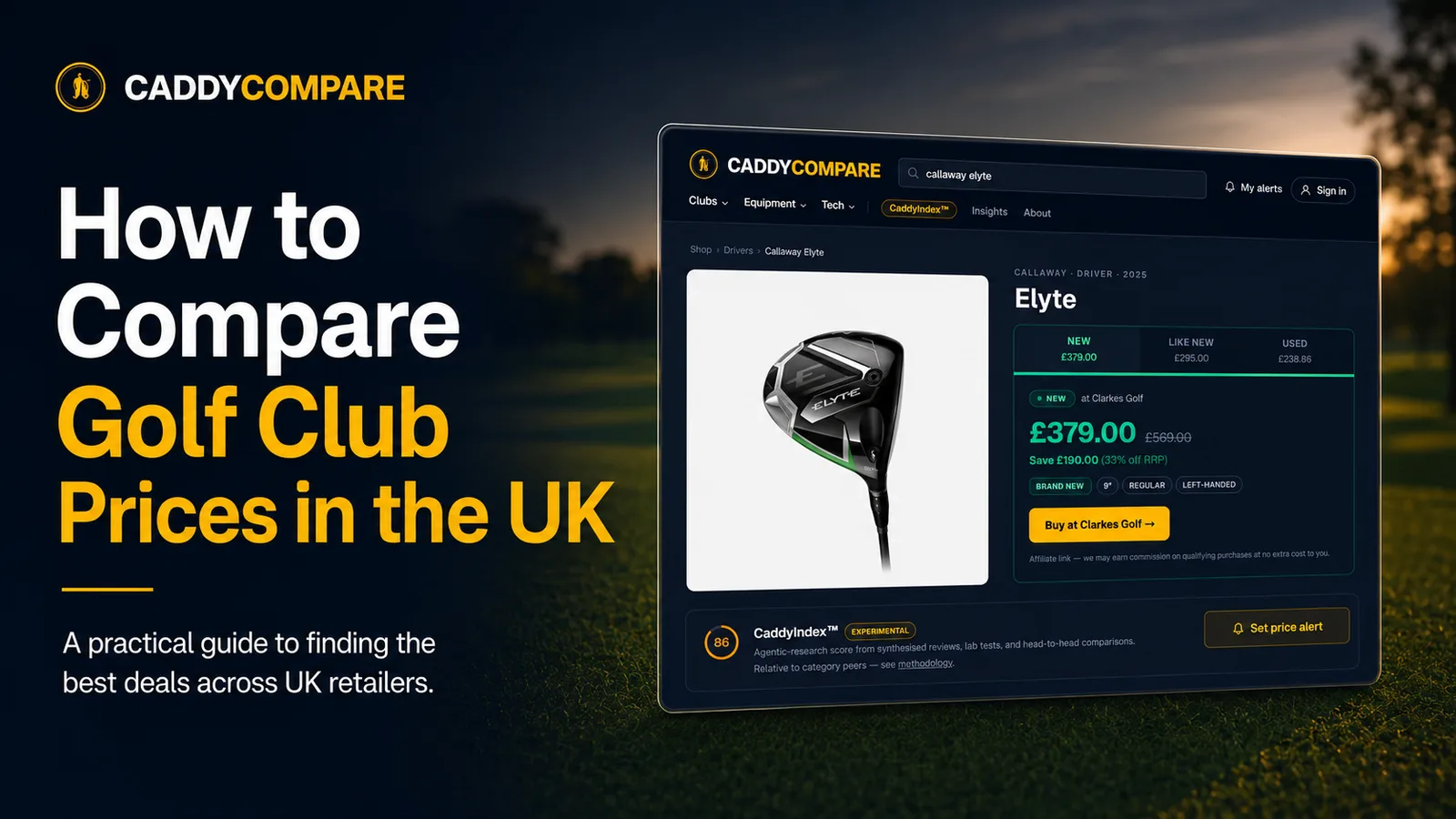
How to compare golf club prices in the UK
Compare golf club prices across UK retailers: why the same driver lands at four different prices, what to read in the small print, and how to spot real value.
Spend an hour shopping around for a new driver and you'll discover something that takes most golfers by surprise: the price isn't really one number. The same exact club, in the same exact spec, can sit at £549 on one retailer's site, £499 on another, £459 on a third, and £379 on the fourth with free postage. Same product, four prices, all live, all in the UK.
That spread is the reason price comparison sites exist. This guide walks through why those numbers don't line up, what to look at when you're choosing between them, and how to make sure the "great deal" you're looking at is actually a great deal.
Why golf retailers price the same product differently
A few different forces are pulling the price in different directions at any given time.
Margin and volume strategies. The big-box retailers (Click Golf, Golf Gear Direct, Hot Golf) move a lot of stock and can afford thinner margins on the hot models. Smaller specialists (Clarkes Golf, Dormy) need wider margins on each sale to stay open, so their headline prices are often higher, but they tend to throw in custom-fitting or longer return windows to justify the gap.
End-of-season clearance. Golf has a model cycle. Most major brands launch new clubs in January or February, and the previous year's models start dropping in price by July. By October the year-old generation can be 40% cheaper than its launch price. This isn't a sale in the usual retail sense, it's the back of the cycle.
Demo and ex-display stock. Most retailers run a demo programme where the same fitting head gets passed across the country, then sold off at a discount once enough golfers have hit it. Demo stock is usually flagged as such; ex-display is sometimes not. The clubs are fine for play but the cosmetic condition varies.
Parallel imports. A handful of smaller online sites bring in stock from outside the UK distribution channels. The price is genuinely lower, but warranty coverage is murkier, and you're sometimes buying a US-spec head that's labelled differently on the sole.
Used / Like new / refurbished pricing. A driver that was £549 new in 2024 is often £329 as a Like new return today, and £229 used by 2026. The discount looks dramatic, but the cosmetic condition is real and so is the saving.
What to look at, not just the price tag
The headline number is only part of the picture. Here are the things to keep an eye on when you're comparing.
Postage. A £369 driver with £8 postage is £377 in your wallet. A £359 driver with £14 postage is £373. The cheaper headline isn't always the cheaper total.
Condition grading. If you're buying used, the grading scale matters enormously. Most reputable UK retailers run a 4-tier system: As new, Excellent, Good, Fair. "Excellent" usually means cosmetic marks invisible from address; "Good" can mean obvious sole wear that won't affect play but will affect resale. Read the grading definitions before you assume two retailers mean the same thing by the same word.
Return policy. Big retailers usually offer 30-day returns, sometimes longer. Smaller specialists vary. If you're buying a driver without hitting it first, the return window is genuinely part of the price. A £20 saving on a club you can't return isn't a saving.
Warranty cover. New clubs from a UK distributor come with manufacturer warranty (typically 12 to 24 months). Parallel imports often don't, or the warranty has to be claimed via a different country. Worth checking before you buy.
What "RRP" actually means. RRP is the Recommended Retail Price the manufacturer sets at launch. Many retailers anchor sale prices against RRP for a long time after the model has dropped naturally in price. "Was £575, now £329" looks great until you realise the model has been sitting at £329 across the market for six months.
A worked example: comparing three retailers on the same driver
Three retailers, same driver (let's say a 2024 TaylorMade Qi10 Max), same spec (10.5° head, regular flex Ventus Blue shaft, mid-length grip), all listed today.
- Retailer A: £429 headline, £8 standard postage, 30-day returns, UK distributor warranty. Total £437.
- Retailer B: £399 headline, free postage over £100, 14-day returns, UK distributor warranty. Total £399.
- Retailer C: £379 headline, £6 postage, no specified returns, parallel import (US-spec head). Total £385.
The naive answer is Retailer C. The right answer depends on what you value. If you're confident in the spec and the saving matters most, C wins. If you want the long return window so you can hit it on the range before committing, A wins. If you want a clean balance of price and reassurance, B is the obvious pick. None of these are wrong, but they're not the same purchase.
This is why a price comparison site that just sorts on headline number can be misleading. The cheapest cell in a table isn't always the cheapest in reality. Worth two minutes of clicking through to read the postage and returns small print before you commit.
How CaddyCompare fits in
We aggregate live prices on golf clubs and equipment from the UK retailers that publish reliable feeds, refresh daily, and surface the spread on a single product page. Click through to whichever retailer wins on the day and you complete the purchase on their site, not ours. We never see your payment details, we don't repackage products, and the affiliate commission we earn when you click through is small and never affects which retailer ranks first in our results.
Same logic applies to the rest of your bag. We run the same comparison on golf balls, rangefinders, GPS units, launch monitors, trolleys and bags. Drivers are the most popular comparison search, but if you're shopping any major piece of golf gear, the same retailers, the same margins and the same end-of-season cycle apply.
Quick tips for comparing golf club prices
- Compare prices at the model level, not the retailer level. Start from the club you want, not from a retailer's homepage. CaddyCompare's shop pages sort the market by model, not by who's selling it.
- Filter on condition. If you'd be happy with a Like new return, the savings are real and the cosmetic difference is often invisible at address. The driver shop page makes this easy.
- Read the CaddyIndex™ entry for the model. It tells you whether the club's actually highly rated or just heavily marketed. Worth knowing before you commit £400.
- Check the price history. A "today only" sale that's been at the same price for two months isn't actually a sale.
- Don't ignore the rest of your bag. A £40 saving on a wedge plus a £50 saving on a GPS is the same as a £90 saving on a driver. Bag-wide comparison is where the real wins are.
Looking for a specific category to start with? Drivers, iron sets, putters and wedges are the four most-compared categories on the site, and a good place to begin. Worth pairing the price comparison with a few related reads: our pick of used drivers under £250 and new iron sets under £500 walk through value picks at the price points most amateurs land at, and the club gapping calculator helps you decide which slot in the bag is actually worth spending on next.