Best irons for high handicappers: forgiving, easy to launch, and three we'd buy
The most forgiving irons for higher handicappers, what a full set should cost, and three picks from the CaddyIndex high-handicap scores, priced pre-owned.
You hit your irons into most greens, so that's where a wandering strike costs the most. As a higher handicapper you'll catch plenty of shots thin, heavy or out of the toe, and the right iron keeps those misses in the air and close to the line. A thin topline or a forged badge won't help with any of that.
Forgiving irons also change slowly from one season to the next. Last year's set does almost everything this year's does, and bought pre-owned it costs well under new.
What makes an iron forgiving
A wide sole skids through the turf when you catch it heavy instead of digging in, and weight set low and deep in the head gets the ball airborne off a thin strike. Those two features are what game-improvement irons are built around.
Perimeter weighting (high MOI) moves weight out to the heel and toe, in a cavity back or a hollow body, so the face twists less on an off-centre hit. The ball flies straighter and keeps more of its distance.
Offset sets the face slightly behind the hosel, which gives it a fraction longer to square up at impact. Some heads add a draw bias on top to straighten a left-to-right miss.
Modern game-improvement irons carry strong lofts, but the low, deep centre of gravity still launches them high enough to stop on a green. If your swing speed is on the slower side, the high-launch ("HL") versions launch higher still.
Our game-improvement irons explainer covers how these heads differ from blades and players irons in more detail.
How much should a full set cost?
A full set is six or seven clubs, usually 5-PW or 4-PW. For a higher handicapper, about £400 to £700 is the sensible range.
- £400 to £500 buys a max-forgiveness set from the last season or two, new on clearance or pre-owned. That's all most golfers need.
- £500 to £700 buys a current-generation set pre-owned or like-new, well under its new price.
- Over £700 gets you this season's flagship new. The extra money pays for the newest model; the forgiveness is close to last season's.
A listing that reads "6-9" or "7 to GW" is a part-set of four or five clubs, which is why it looks cheap. We leave part-sets out of the prices below, so every card compares full sets.
Three iron sets we'd buy
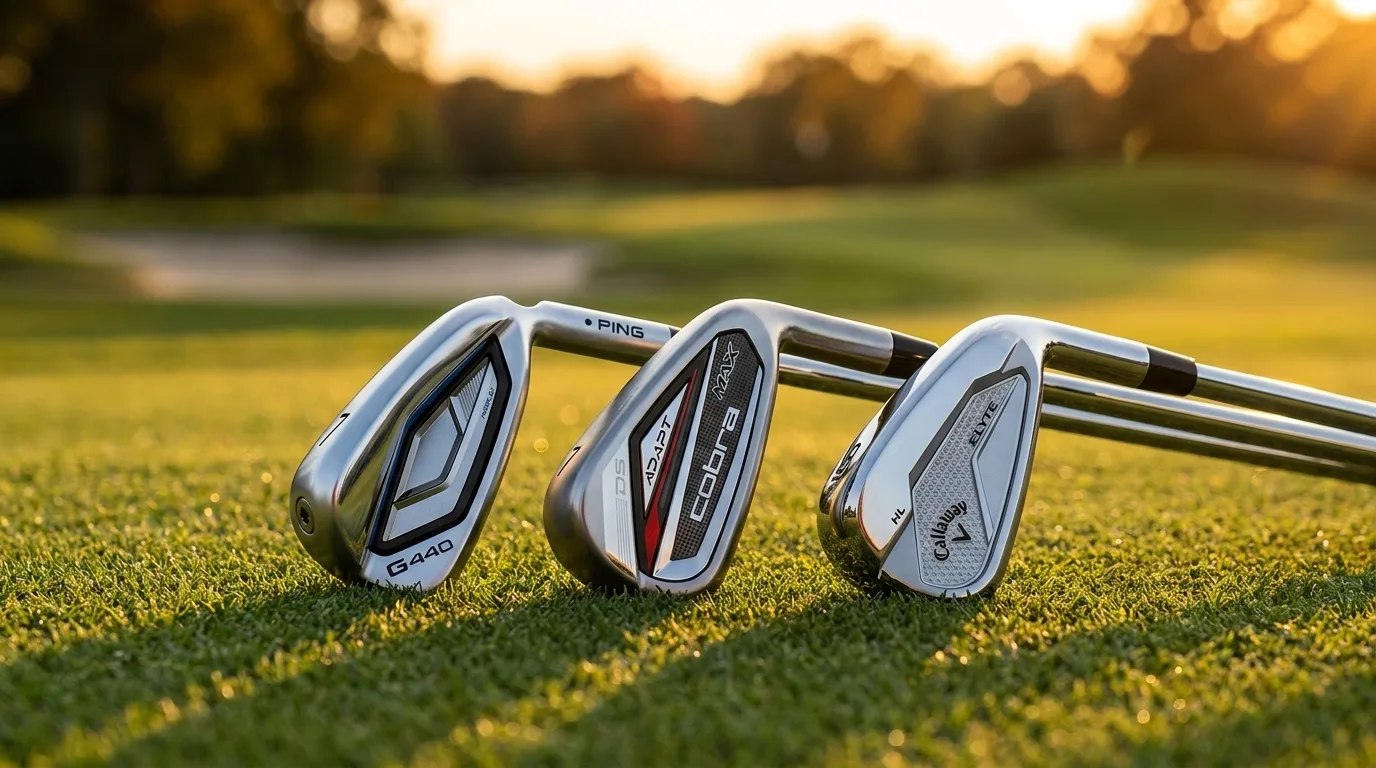
We picked these three from the top of our CaddyIndex high-handicap scores, one per brand and spread across the budget. Each card shows the cheapest pre-owned full set, and tapping through shows every condition, set make-up and retailer. The iron shop page lists the rest.
CaddyIndex™
Higher-handicap score
The budget option, and the one for slicers. A super game-improvement head built for slower swings, with a draw bias that straightens a left-to-right miss and a high, easy launch. If the ball keeps leaking right, start here.
CaddyIndex™
Higher-handicap score
Our pick. The G440 rates among the most forgiving irons made and scores well for distance, and it looks slimmer at address than most irons this easy to hit. Pre-owned, it sells for well under its new price.
CaddyIndex™
Higher-handicap score
The high-launch version of Callaway's 2025 Elyte iron, built for slower swing speeds. It gets the ball up and lands it softly, which suits seniors and anyone short on carry.
Most higher handicappers should start with the Ping G440, which is one of the most forgiving irons made and sells pre-owned for well under its new price. The Cobra DS-ADAPT Max suits slicers and the tightest budget. The Callaway Elyte HL is the one if your swing speed is slower and you struggle to get the mid irons up.
How we picked these
Every club in our CaddyIndex carries a per-handicap score, synthesised from third-party expert reviews and lab-test data and rated for each ability level. We ranked the iron sets by the higher-handicap rating and set aside the players-distance and low-spin heads, which rate well overall but are built for a better strike. We kept to one set per brand and only picked sets we could find in stock as full sets, because a part-set makes a model look cheaper than it is.
Buying a used iron set: what to check
- Count the clubs. 5-PW is six clubs and 4-PW is seven, while "6-9" is four and "7 to GW" is five. Make sure the listing photo matches the description.
- Get the shaft right. For a lot of higher handicappers the shaft's flex and weight matter more than the head, and lighter shafts help a slower swing. Our shaft flex calculator gives you a starting point.
- Look at the short irons first. The 8, 9 and PW get hit the most, so check their faces and grooves for wear.
- Check the lie. A set fitted for someone else may have been bent upright or flat; Ping marks this with a coloured dot, and black is standard.
- Budget for grips if the old ones are shiny, hard or cracked. They're an easy fix.
- If your set stops at PW, check the jump to your sand wedge. The club gapping calculator shows whether you need a gap wedge.
Frequently asked questions
What are the most forgiving irons for a high handicapper?
Max-forgiveness game-improvement irons. Heads like the Ping G440, Callaway Elyte HL and Cobra DS-ADAPT Max use a wide sole, a low centre of gravity and perimeter weighting, so thin and off-centre strikes still get airborne and fly straighter. The exact best changes from season to season, but any current or one-year-old max-forgiveness set from the big brands is far easier to hit than a players iron or a blade.
How much should a high handicapper spend on irons?
About £400 to £700 for a full set. That buys a max-forgiveness set from the last season or two, new on clearance or pre-owned, or a current-generation set bought pre-owned or like-new. Forgiving irons change slowly from year to year, so paying over £700 for this season's set new mostly buys the newest model.
Are used irons a good idea for a high handicapper?
Yes, as long as you check what you're buying. Iron heads wear slowly, so a pre-owned set is mechanically close to new at a big saving. Count the clubs and confirm the set make-up, check the faces and grooves on the short irons, make sure the shaft flex suits your swing, and budget for new grips if the old ones are worn.
What is the difference between a 5-PW and a 4-PW iron set?
A 5-PW set has six clubs: the 5, 6, 7, 8 and 9 irons plus the pitching wedge. A 4-PW set adds the 4-iron for seven clubs. Most higher handicappers are better off with the 5-PW set and a hybrid in place of the 4-iron, because a hybrid is far easier to launch from the fairway and the rough.
What does HL mean on irons?
HL stands for high launch. It's a lighter, higher-launching version of a standard iron, such as the Callaway Elyte HL or Ping G440 HL, built for slower swing speeds. If you struggle to get your mid irons up in the air or to stop them on a green, an HL set is worth a look.
Do high handicappers need graphite shafts in their irons?
Not necessarily. Graphite is lighter, which helps a slower swing generate a little more speed and launch, so it suits many seniors and anyone short on carry. At a moderate swing speed, a light steel shaft in the right flex works well. Pick the shaft for your swing speed first and the material second.
Should a high handicapper play forged irons or blades?
No. Blades and most forged players irons have a small sweet spot and a thin sole, so they punish the off-centre and heavy strikes a higher handicapper makes. A max-forgiveness cast or hollow-body iron keeps more of your misses on line and in the air, and that does far more for your scores than the softer feel of a forged head.
The iron shop page has live UK prices for new and used sets. If you'd rather buy new, see our best new iron sets under £500, and for a club to replace the long irons, our best hybrid golf clubs guide. The rest of the series is under buying guides.