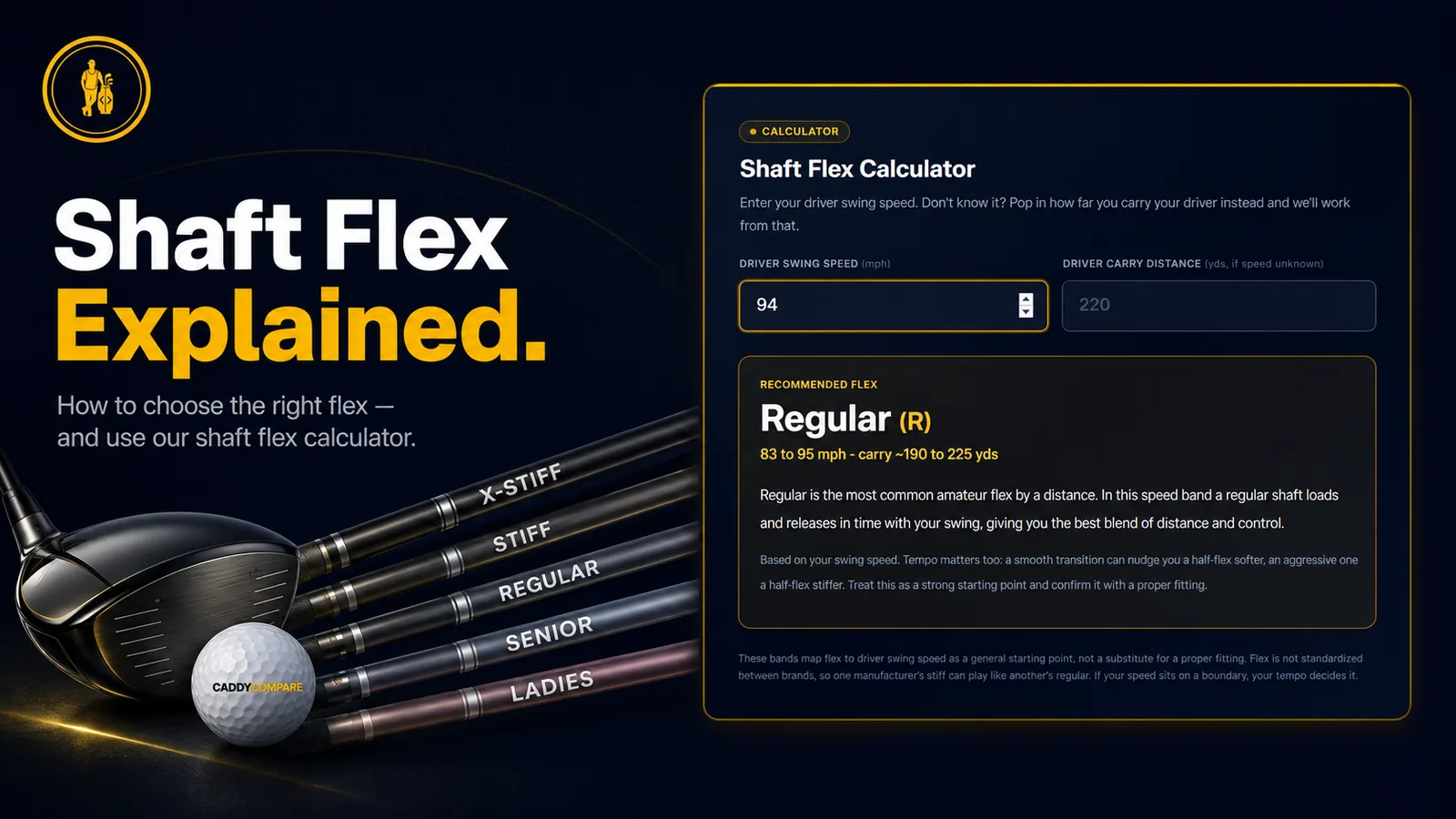
Find your ideal flex - golf shaft flex calculator
Find the right golf shaft flex for your swing. Enter your driver swing speed or carry distance and the calculator returns your flex (L, A, R, S, X), with a swing-speed shaft flex chart and what the flex letters and numbers mean.
Shaft flex is how much a golf shaft bends during your swing, and it is one of the few fitting choices that matters whether you spend £80 or £500 on a club. Play a flex that is too stiff and the shaft never loads, so the ball launches low, feels harsh, and tends to leak right. Too soft and it whips through impact, ballooning the flight and adding a two-way miss. Get it right and your dispersion tightens and you find the middle of the face more often.
The fastest way to land in the right range is to match flex to your driver swing speed. The calculator below does that for you. If you have never measured your speed, enter how far you carry your driver instead and it will work from that.
Shaft Flex Calculator
Enter your driver swing speed. Don't know it? Pop in how far you carry your driver instead and we'll work from that.
Your recommended flex will appear here.
These bands map flex to driver swing speed as a general starting point, not a substitute for a proper fitting. Flex is not standardized between brands, so one manufacturer's stiff can play like another's regular. If your speed sits on a boundary, your tempo decides it.
Golf shaft flex chart by swing speed
Match your driver swing speed to the band below. Swing speed is the primary signal; the carry figures are an approximate guide for when you do not know your mph (use your carry, the distance the ball flies in the air, not total roll-out).
| Flex | Driver swing speed | Carry (approx) | Best for |
|---|---|---|---|
| LLadies | Under 71 mph | under ~165 yds | Slower, smoother swings |
| ASenior | 71 to 82 mph | ~165 to 190 yds | Senior and smooth-tempo players |
| RRegular | 83 to 95 mph | ~190 to 225 yds | Most amateur golfers |
| SStiff | 96 to 103 mph | ~225 to 250 yds | Strong, faster swings and low handicaps |
| XX-Stiff | 104 to 114 mph | ~250 to 275 yds | Very fast swingers |
| TXTour X | 115+ mph | ~275+ yds | Elite, tour-level speed |
Most recreational golfers fall into regular or stiff. If you sit right on a boundary, your tempo decides it: a smooth, gradual transition suits the softer side, a sharp, aggressive one the firmer side.
What the shaft flex letters and numbers mean
Flex is marked on the shaft with a letter, and some shafts (most famously Project X and other True Temper steel) use numbers instead. Here is how they line up:
| Marking | Flex | Where it sits |
|---|---|---|
| L | Ladies | the softest standard flex |
| A / M | Senior | one step softer than regular |
| R | Regular | the standard amateur flex |
| SR | Senior-Regular | between regular and stiff |
| S | Stiff | one step firmer than regular |
| X | Extra stiff | firmer than stiff |
| TX / XX | Tour X | the firmest, tour-only |
| Number | Equivalent flex |
|---|---|
| 5.0 | Regular |
| 5.5 | Firm regular / soft stiff |
| 6.0 | Stiff |
| 6.5 | Extra stiff |
| 7.0 | Tour X |
You may also see R2 (a softer regular) on some graphite shafts. One important caveat: flex is not standardized across brands. One manufacturer's stiff can play like another's regular, because the weight, profile, and bend point of the shaft all change how it feels. Treat the marking as a starting point, not a guarantee.
How to find your shaft flex without a launch monitor
You do not need any equipment. Take your average driver carry distance, the distance the ball actually flies before it lands, and read it off the chart above. Ignore roll, which changes too much with ground conditions to be reliable. A drive that carries around 200 yards puts most golfers in regular; around 240 yards in stiff. If you can get a free swing-speed reading at a fitting day or a golf retailer, that is more precise still.
What about irons and wedges?
The chart above is for the driver, your fastest and longest club, which is why it is the standard reference point. Iron flex roughly tracks your driver flex, so a regular-flex driver player is usually in regular iron shafts too. The bigger iron decision is steel versus graphite: steel is heavier and more consistent for most players, while graphite is lighter and helps slower or senior swings add a little speed. If you are between flexes in irons, fitters often size off your 6 or 7-iron carry rather than the driver.
Frequently asked questions
What golf shaft flex should I use?
Match flex to your driver swing speed: under 71 mph is ladies, 71 to 82 mph is senior (A), 83 to 95 mph is regular, 96 to 103 mph is stiff, 104 to 114 mph is extra stiff, and 115 mph or more is tour X (TX). If you do not know your swing speed, use your driver carry distance instead, where regular is roughly 190 to 225 yards of carry. Most amateurs end up in regular or stiff.
How do I determine my shaft flex without a launch monitor?
Use how far you carry your driver. Carry is the distance the ball flies in the air, not the total with roll. A carry of around 200 yards points to regular for most golfers, and around 240 yards to stiff. Reading your carry off a swing-speed flex chart gets you close. For a precise number, get a free swing-speed reading at a fitting day or golf store.
What shaft flex should a beginner use?
Most beginners swing the driver around 85 to 95 mph and are best served by a regular flex. The common mistake is going too stiff, which makes the shaft harder to load, lowers your launch, and feels harsh. If you are unsure between two flexes, the softer one is usually the safer choice for a beginner because it helps get the ball airborne.
What shaft flex is best for senior golfers?
Senior flex is about swing speed, not age. If your driver speed has dropped below 83 mph, a senior (A) flex helps you keep launch and feel; below 71 mph, ladies flex is better. Many senior golfers also move to a lighter graphite shaft, which can add a few mph of clubhead speed on its own.
Stiff vs regular: how do I know which I need?
The line sits around 95 to 96 mph of driver swing speed, roughly 225 yards of carry. Above that, a stiff shaft keeps your ball flight and shot dispersion tighter. Below it, stiff feels dead and costs you launch and distance. Signs you are too stiff: a low flight, lost distance, and a harsh feel. Signs you are too soft: a ballooning flight and a two-way miss.
What does a 5.5 flex golf shaft mean?
The 5.0, 5.5, and 6.0 numbers come from Project X and similar True Temper shafts, which use numbers instead of letters. As a rough guide, 5.0 is about a regular, 5.5 is a firm regular to soft stiff, 6.0 is a stiff, and 6.5 is an extra stiff. Because flex is not standardized between brands, treat these as approximate.
Does shaft flex really matter?
Yes, mostly for accuracy rather than raw distance. The wrong flex makes the clubface harder to square at impact, so a too-stiff shaft tends to leak shots right for a right-hander, while a too-soft one balloons and can hook. Getting flex right tightens your dispersion and helps you strike the centre of the face more consistently.
Want to keep dialling in your setup? Browse every driver in our catalog, check the club gapping calculator to find the holes in your bag, see how efficiently you strike it with the driver strike efficiency calculator, or head back to more tools and calculators.