What is CaddyIndex™? How we rate and rank golf clubs
How CaddyIndex rates golf clubs: one 0-100 score per club drawn from the credible reviews and lab tests, six sub-scores, and a rating tuned to your handicap. How it works and how to use it.
Buying a club shouldn't cost you a weekend of YouTube reviews and launch-monitor numbers that never quite agree. So we built CaddyIndex™, an AI research system that does the reading for you and turns all that noise into one number per club you can actually compare.
The full table lives at /caddyindex. This piece explains what the score is, how it's built, how it adjusts to your handicap, and how to use it without reading too much into it.
What is CaddyIndex™?
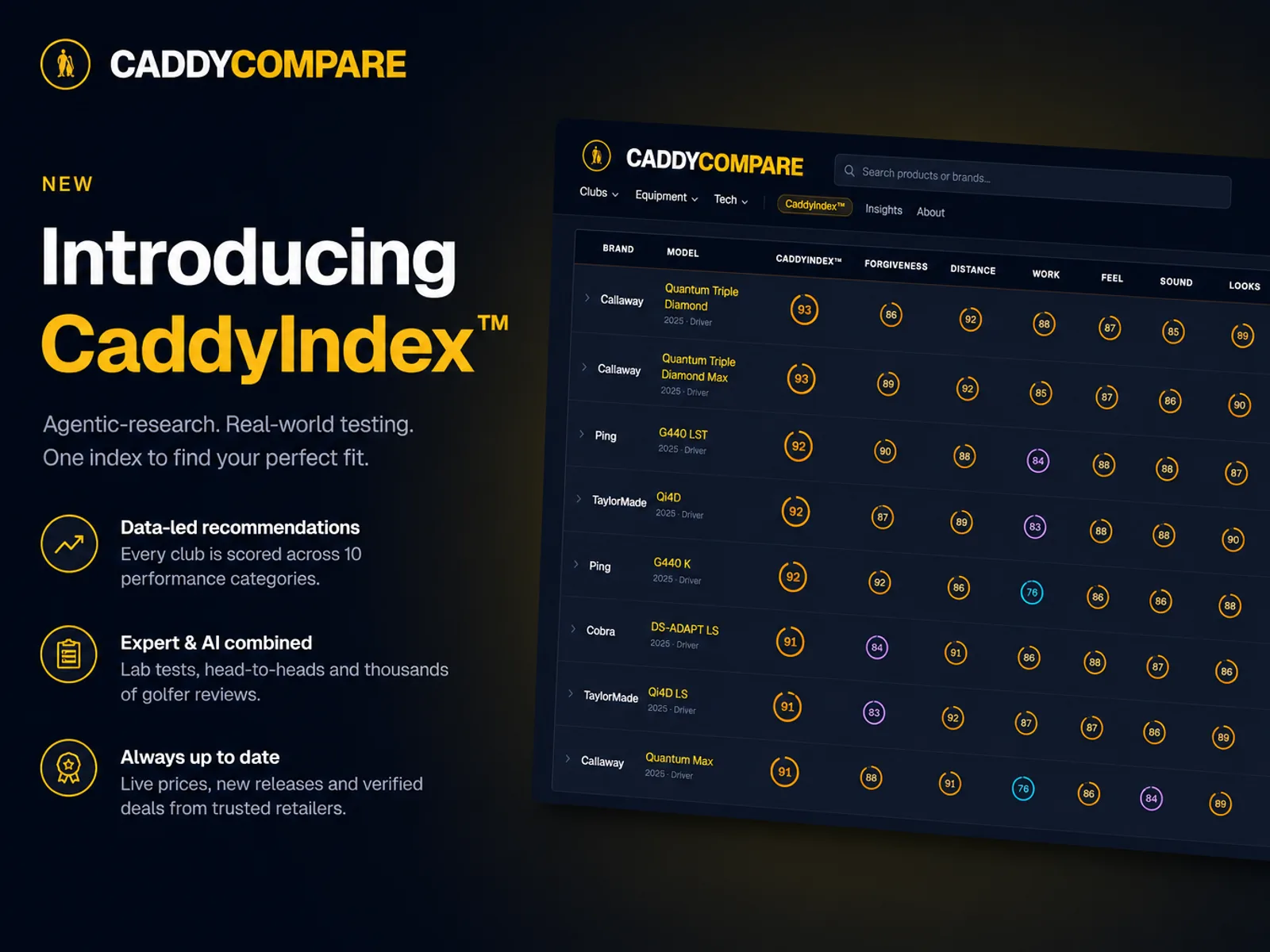
For every club we cover, an AI research agent reads the credible reviews, lab tests and head-to-head comparisons it can find across the open web. A scoring system then distils all of that into six performance areas, the things that actually matter when you're shopping, and rolls them into a single CaddyIndex™ score from 0 to 100.
Think of it as a research assistant that has read everything for you and handed back one number to start from. It's a starting point, not a verdict.
How is a golf club scored?
The pipeline runs in two stages, and neither one involves anybody swinging the club.
Research. An AI agent searches the open web for everything written about a specific club: reviews from outlets like Plugged In Golf, Today's Golfer, MyGolfSpy and GolfWRX, robot-test data from buyer's-guide round-ups, and head-to-head comparisons against direct rivals. It pulls out the signals that map to each of the six areas we score.
Grading. A scoring system turns those signals into 0-to-100 ratings for each area, applies a confidence gate when the evidence is thin (more on that below), and rolls them into the single CaddyIndex™ score.
Both stages are AI-driven. The result is a synthesis of what the reviewers and lab testers already found, rated and made comparable. It is not a fitting, and nobody at CaddyCompare hits a shot to produce it.
We write every summary in our own words, and we generalise what independent tests found rather than reproducing any single outlet's rankings, scores or data tables. Every source is credited and linked on the club's page so you can read the full review where it was published.
What the six sub-scores mean
Every club is rated across the six areas that show up most consistently in equipment reviews:
- Forgiveness. How the club holds up on off-centre strikes: MOI, ball-speed retention on toe and heel misses, dispersion.
- Distance. Carry and total yardage against its category peers.
- Workability. How easily you can shape a shot on purpose, a draw or a fade, against a one-shape head.
- Feel. The tactile feedback at impact: solid, fast, dampened or harsh.
- Sound. The acoustic signature: crack, thud, ping or muted.
- Looks at address. Head shape, alignment cues, and how confident the club looks sitting behind the ball.
Those six roll into one CaddyIndex™ score so you can compare clubs at a glance. Care more about forgiveness than distance? Sort the table by that sub-score directly.
Scores tuned to your handicap
A scratch player and a 24-handicapper don't want the same driver, so a single overall number was never going to be the whole story. Alongside it, every club carries a rating for each ability band: higher (21+), mid (13-20), lower (5-12) and tour (0-4). The same club can rank differently depending on who's swinging it, because forgiveness matters more to one player and workability to another.
Pick your handicap on the leaderboard and the table re-ranks to float the clubs that suit your game to the top. You can see this in practice in our best drivers for high handicappers guide, which ranks purely by the higher-handicap rating.
How to use CaddyIndex™ when you buy
Open /caddyindex and:
- Set your handicap so the ranking reflects your ability, not a tour pro's.
- Sort by any sub-score to surface the clubs strongest where it matters to you.
- Filter by category, tag (low-spin, max-forgiveness and the like), year, score range and condition (new, like new, used).
- Open a club's page to read the full breakdown: every sub-score's reasoning, who it suits, who should skip it, and the sources behind the rating.
- Tap a price to jump to the product page, where you'll find every retailer carrying the club and its full price history.
How accurate is CaddyIndex™?
We'd rather be straight about the limits than oversell.
A few specifics worth holding in mind:
- It's not variant-aware yet. A driver is rated as a head; we don't currently split by loft, shaft or flex. The price on the CaddyIndex™ page is the cheapest variant in stock, so your fitted spec may cost more.
- Looks is subjective. Two reviewers can score the same head 7 out of 10 and 4 out of 10 for looks. We lean on consensus where it exists and weight it more cautiously where it doesn't.
- Confidence gating. When the evidence on a club is thin (few reviews, no robot-test data, an obscure model), we hold the published score back rather than overclaim.
- The rubric evolves. The scoring rules keep changing as we learn what matters most, so clubs get re-rated as the system improves.
What's next
We're not finished. The steps we care about most:
- Variant-aware pricing, so the table can show per-spec prices instead of the cheapest variant in stock.
- A glanceable confidence indicator on each row, so you can tell a well-evidenced score from a baseline-blended one at a look.
- Wider and fresher coverage, adding new releases quickly and re-rating older clubs as the rubric improves. We already span drivers, fairway woods, hybrids, irons, wedges and putters, and the catalogue keeps growing.
Frequently asked questions
What is CaddyIndex?
CaddyIndex is a 0-to-100 rating for a golf club, built by an AI research system that reads the credible reviews, lab tests and head-to-head comparisons across the web and distils them into six performance sub-scores plus one overall number. It's a fast, comparable starting point for choosing a club, not a substitute for a fitting.
Is CaddyIndex based on real golf testing?
Not our own. CaddyIndex synthesises the testing and reviews that professional outlets and lab testers have already published; nobody at CaddyCompare hits shots to produce a score. It's a research synthesis, rated and made comparable, rather than a fresh launch-monitor session, which is also why we call it experimental.
What do the six CaddyIndex sub-scores mean?
Forgiveness (performance on off-centre hits), distance (carry and total against category peers), workability (how easily you can shape a shot), feel (impact feedback), sound (acoustic signature) and looks at address (shape and alignment confidence). Each is rated 0 to 100, and the six roll into the overall score.
Does CaddyIndex adjust for my handicap?
Yes. Alongside the overall score, every club carries a rating for higher (21+), mid (13-20), lower (5-12) and tour (0-4) handicaps. Pick your band on the leaderboard and the table re-ranks so the clubs that suit your ability rise to the top.
Is a higher CaddyIndex score always better for me?
Not necessarily. A high overall score means a club rates well across the board, but the right club for you depends on what you need. Set your handicap and sort by the sub-score that matters most, forgiveness if you're fighting your misses, workability if you like to shape it. And no score is a promise a club suits your swing, which is what a fitting is for.
Which golf clubs does CaddyIndex cover?
We rate across the bag: drivers, fairway woods, hybrids, irons, wedges and putters, with the catalogue growing all the time. If a club you want isn't rated yet, it's most likely on the way.
Is CaddyIndex free to use?
Yes. The full leaderboard at /caddyindex is free, and every score links through to live UK prices across new, like-new and used, so you can act on it straight away.
Try it now at /caddyindex. Spotted a club we should rate next? Tell us. And for buying help that puts these scores to work, browse our buying guides.