What is a rangefinder, and how do you actually use one?
A plain-language guide to laser rangefinders for golf: how they work, what you see through the eyepiece, and three units worth buying right now.
Spend a Saturday at a busy club and you'll see them on every other tee. Small black handhelds, raised to one eye, pointed at the flag for a second or two before the player goes back to picking a club. Those are laser rangefinders, and over the last decade they've quietly become the way most amateur golfers measure distance to the pin.
This guide is for anyone who's never used one and isn't sure what they'd be paying for. We'll walk through what's actually happening when you press the fire button, what you see when you look through the eyepiece, and how to use the thing on a real course. At the end there are three rangefinders we'd happily buy ourselves today: a premium pick, a value pick, and the one currently living in the CaddyCompare bag.
How a rangefinder works
Under the hood every laser rangefinder is doing the same trick. It fires a tightly focused pulse of infrared light out the front, waits for that pulse to bounce off something and come back, and times the round trip. Multiply that time by the speed of light, divide by two (the pulse went out and came back, so the actual distance is half of what the light travelled), and you've got the distance to whatever the laser landed on.
Speed of light being what it is, the round trip from your tee to a flag 150 yards away takes about a microsecond. Your rangefinder doesn't fire one pulse, it fires a quick burst of them, throws away the outliers, and shows you the most consistent reading. That's why the number on the display sometimes settles for half a second before you see the final figure.
Two follow-on features matter on the course.
Pin-seeker (or flag-lock). The unit knows that the flag is the smallest, closest object inside your aiming reticle, and that there's usually a tree or a bank somewhere behind it. So when it sees a close, isolated return, it locks on and tells you, usually with a little vibration, sometimes a ring on the display, often a soft beep. Without this trick, aiming at a flag with trees behind it would constantly bring back the distance to the trees. Useless.
Slope. A second sensor inside the unit reads the angle of the shot. If the pin is above you, it adds yards; below you, it subtracts. You see both numbers: the raw line-of-sight distance, and the slope-adjusted "play" distance to use for club choice. Tournament rules ban slope, so anything decent has an external switch (a coloured window, a red-to-black tab, etc.) that turns slope off in a way the rules officials can see at a glance.
What's inside a rangefinder
The casing of a rangefinder is doing a few different jobs at once. Here's a side view of a typical unit with the parts labelled.
The bit you point at the flag is the objective lens at the front. The laser fires out through that lens, and the bounced-back pulse comes back through it. Newer units squeeze a tiny display projector in there too, which is what writes the distance number onto your view of the world. You look through the eyepiece at the back. Rotate the diopter ring (the textured ring around the eyepiece) once on day one to focus the reticle to your eye, then leave it alone. Most units have a magnetic strip running along one side so you can stick the unit to the steel frame of a buggy or trolley between holes. That magnet matters more than you'd think; we'll come back to it.
What you see through a rangefinder scope
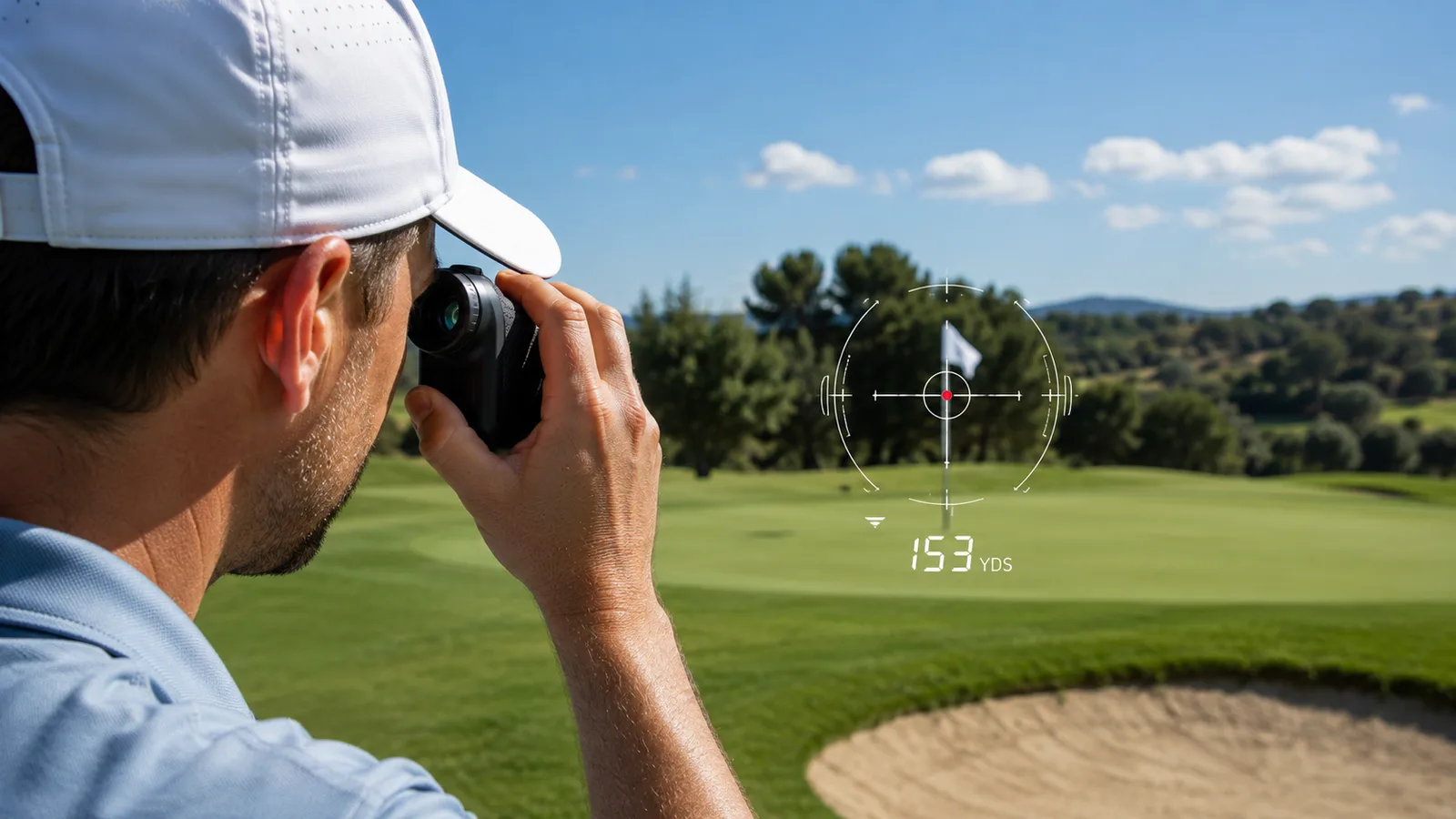
This is the part nobody tells you about until you've held one. The view through a rangefinder isn't some heads-up sci-fi display. It's a small dim circle with the world inside it at about 6x zoom, with a thin black or amber reticle in the middle and a yardage number overlaid on top.
Through the eyepiece you get a small dim circle with the world inside it at about 6x zoom. Frame the flag inside the corner brackets of the reticle, press the fire button, and the readings appear over the view.
- Raw line-of-sight distance to whatever the laser locked on to.
- Slope-adjusted distance. Use this for club choice when slope mode is on.
- Flag-lock confirmation. Usually paired with a vibration through the body so you know without looking.
The brackets in the middle are what you aim with. Frame the flag inside them, press the fire button, and the readings appear either right next to the reticle or along the bottom of the view. On most units a small ring or icon flashes to confirm flag-lock and a soft vibration runs through the body. If slope is on, you'll see a second smaller number underneath the raw distance (often labelled "PLAY" or with an up/down arrow). That's the slope-adjusted figure to use for club selection.
The display is dim on purpose. A bright OLED overlay would wash out the view of the flag in low light. Most units have a brightness ring or auto-adapter that lifts the readout on bright days and dims it at dusk.
How to use a rangefinder without slowing the group down
Once it's in your hand the routine is short.
- Bring the unit up to your dominant eye and frame the flag inside the reticle.
- Press the fire button. Hold steady (no need to squeeze, there's no recoil to fight).
- Wait for the vibration or lock confirmation, glance at the number, lower the unit.
- If slope is on, use the play distance, not the raw distance, for club choice.
A few things people get wrong the first few times:
- Aim at the top half of the flag, not the bottom. The reticle on a rangefinder is small but the laser beam itself is even smaller. People miss the flag and end up reading the green or the bunker behind it. Frame the top of the flag if you're not confident your hand is steady.
- Don't try to be still as a statue. A tiny wobble is fine; the burst of pulses averages it out. People who tense up actually shake the unit more.
- Re-shoot if the number looks weird. If your last shot was 156 and the next reading says 92, the laser hit a guy on the next fairway, or the rake by the bunker, or a sprinkler head. Just fire again.
- Charge the battery or pack a spare. Modern lithium units typically hold a charge for thousands of shots. Older CR2 button-cell units die at the worst time. A spare battery in the bag pocket is a one-pound piece of insurance.
Three rangefinders we'd actually buy
These are the rangefinders we'd actually spend our own money on right now. Prices move around, so click through for the current best UK price. The full rangefinder catalog shows everything our retailers stock if you want to widen the search.
The tournament-spec premium pick. Fastest pin-lock you can buy, slope toggle that goes red-to-black so officials can see it's off, and the build feels like it'll outlast your putter.
A laser rangefinder and a GPS in one body. You get flag-lock and slope, plus front/middle/back of green distances and full shot tracking through the free app. Daft value for the price, and it's the one in our own bag.
The cheapest brand-name unit worth recommending. Bushnell's pinseeker, 6x optics, proper case, but no slope and no magnetic mount. If you just want a yardage and don't play comps, this is the floor of the market without going own-brand cheap.
If you're picking just one and want the short version: the Shot Scope Pro LX is the one we'd point most golfers at. You get a proper laser unit, full GPS on top, and shot tracking through the free app, all in one device. The Bushnell still wins on optics and pure laser speed, and the Precision Pro is the cheapest way in if you're not sure how often you'll use one. None of the three are bad buys.
Buying a rangefinder: what to actually check
- Buy used carefully but happily. Rangefinders age well. The optics don't fade, the laser doesn't lose accuracy, and the magnetic mounts are usually still good after years of use. A two- or three-year-old unit at half the price of new is fine. Check the slope switch moves smoothly through both positions and look for condensation inside the eyepiece (a sign the seal has gone).
- Magnetic mount matters more than the spec sheet suggests. The number-one cause of broken rangefinders is dropping them off a buggy. A unit with a strong magnet in the body sticks to the steel frame next to your seat and stays there round after round. A unit without one needs a strap or a buggy holster, both of which get forgotten.
- Don't overrate range claims. A unit that says "1000 yards max" doesn't matter for golf. What matters is fast, accurate locks at 150 to 250 yards on a thin flag with trees behind it. Reviews that explicitly test flag-only lock distance (not maximum range against a reflector) are the ones worth reading.
- Get a case with a belt loop or a clip. Stuffing the unit into a side pocket and forgetting it's there is how you end up scratching the lens against your tees.
Frequently asked questions
Are golf rangefinders worth the money?
For most golfers, yes. A laser rangefinder gets you the exact yardage to the flag in a couple of seconds, which beats pacing off sprinklers or trusting the yardage book at most amateur courses. The biggest win is in slope: even a few degrees of elevation change is worth half a club, and judging that by eye is genuinely hard. Decent units start around 150 pounds new and a lot less used, which works out to a few pounds per round for anyone playing once a week.
Rangefinder vs GPS: which should I buy for golf?
Rangefinders give you exact distances to anything you can see, but only to things you can see, so they need a clear line of sight to the flag. GPS units give you distances to the front, middle and back of every green plus most hazards from anywhere on the course, even when you're behind trees or in a valley. If you mostly play one or two home courses you've already mapped in your head, a rangefinder is the sharper tool. If you play unfamiliar courses or like a strategic overview from the tee, GPS earns its place. Plenty of golfers carry both for that reason; a Shot Scope Pro LX is a single unit that does both.
How accurate is a golf rangefinder?
Plus or minus one yard at flag distances is typical for any decent unit. The accuracy is fundamentally limited by how steady you hold it and how clean the return off the flag is; on a windy day with the flag moving, you'll see the number jitter by a yard or two. That's well within the margin of error of your own swing on any given shot, so it's not worth obsessing over.
Is slope worth paying extra for in a rangefinder?
For casual play, almost always yes. A 3 to 5 degree slope is worth roughly half a club, and the slope feature does the maths for you. Tournament play is different: slope is banned under the rules, so you need a unit with a clearly-visible off-switch (red-to-black tabs and colour-changing windows are the common designs). A unit without a hard off-switch is risky to own if you ever play stroke-play comps.
How long does a rangefinder battery last?
Modern lithium-rechargeable units typically run for thousands of shots between charges, which translates to months of weekend golf. Older CR2 button-cell units (still found on cheaper models) last a few rounds before fading. The biggest risk isn't running out mid-round; it's forgetting to charge between rounds and finding out on the first tee. A spare battery for button-cell units, or a USB-C cable in the car for the modern ones, takes the worry off the table.
Can I use a hunting rangefinder for golf?
Yes in principle, no in practice. Hunting units measure distance just fine, but they don't have pin-seeker (flag-lock), which means the laser will happily read the trees behind the green instead of the flag. Slope, which is the second-most-useful feature, is also usually missing on hunting units. A purpose-built golf rangefinder isn't much more expensive and is built for the job.
If you want to compare what's currently in our catalog side by side, head over to the rangefinders shop page for live UK prices, or check the GPS units page if you're weighing one against the other. For more in this series, see our other tools and explainers.